How to Build a Winter Knitwear Capsule Wardrobe
A winter wardrobe tends to fail in one of two ways. Either you own four sweaters and have worn them thin by January, or you own fifteen and still stand in front of the mirror at 7:40am with nothing to put on. A capsule fixes both problems, because it treats knitwear as a system rather than a pile. Ten well-chosen pieces can cover a Monday meeting, a Saturday market and a dinner out, without a single panic purchase in between.
Start With How You Actually Spend Winter
Before you buy anything, count the days. Most of us dress in one of three modes between November and March: work or study, off-duty, and something slightly dressier. Work out roughly how many days a week you spend in each. Four office days and a busy weekend social life means your capsule should lean on fine-gauge knits that sit neatly under a blazer, with one or two thicker pieces for Saturdays. If you work from home and mostly leave the house to walk the dog, that balance flips completely.
Be honest about temperature too. A winter in Manchester and a winter in Milan call for different weights. Layering beats one heavy Aran every time, because you can shed a layer indoors without looking like you're mid-undress.
The Five Sweaters That Do the Heavy Lifting
If you build nothing else, build these. Each one earns its place by working with at least four other pieces in the wardrobe.
- A fine-gauge crew neck in merino or a merino-cotton blend. Thin enough for under a jacket, smart enough for the office, and the piece you'll reach for most often. If you find one that fits beautifully, buy it in two colours.
- A mid-weight roll neck in a dark neutral. It solves the missing-scarf problem and looks deliberate with tailored trousers or straight jeans.
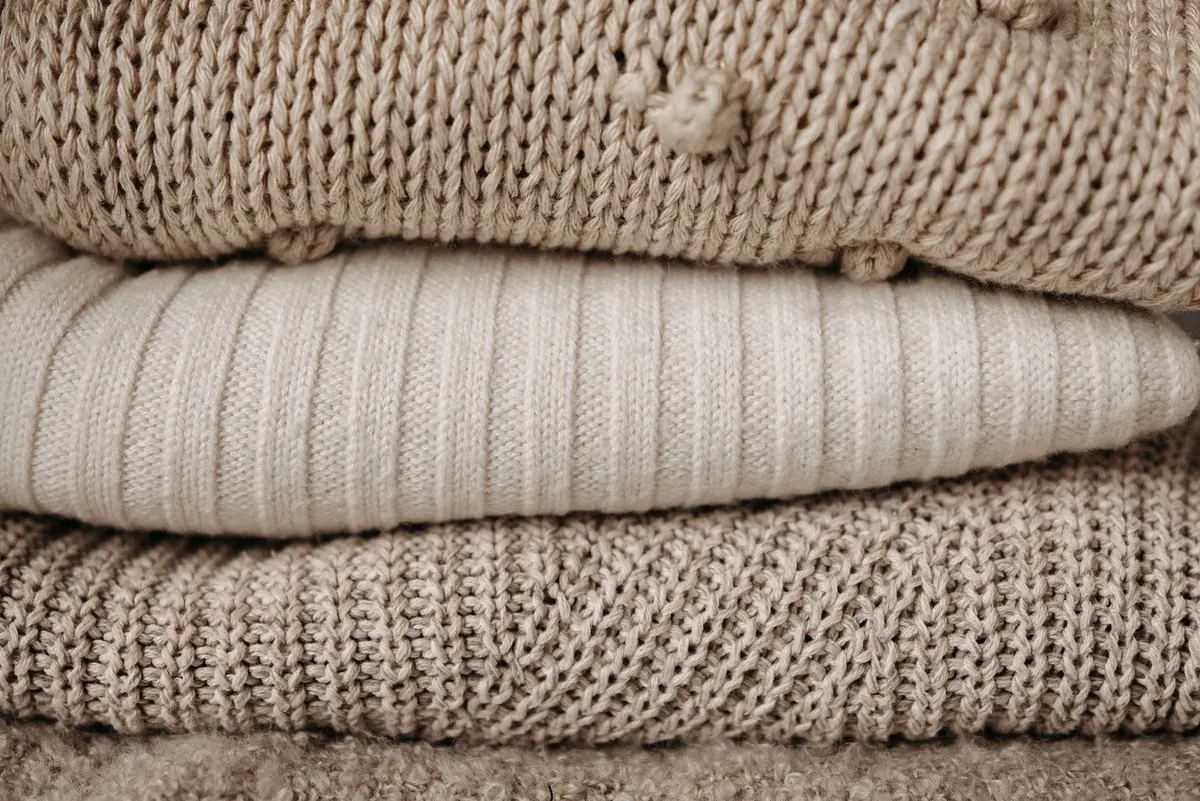
- A chunky textured knit in cable, waffle, rib or a seeded stitch. This is your outdoor piece, the one that carries an outfit of plain jeans and boots.
- A relaxed, slightly oversized sweater in a lighter shade. Something you can pull over a shirt or a slip dress and look intentional rather than rumpled.
- One striped or patterned knit. A Breton stripe, a Fair Isle yoke, a quiet geometric. This is the personality of the capsule. One is plenty; two start competing for attention.
Cardigans and Knit Tops: The Underrated Half
Cardigans are the workhorses of a knit capsule because they change the temperature of an outfit in seconds. Own a button-through wool or wool-blend cardigan in a neutral that finishes at the hip. It works as a light jacket in autumn, a mid-layer in deep winter, and a cardigan over a dress when you want to look like you made an effort. Then add a longer, open-front knit in a heavier yarn for days when you want a coat substitute indoors.
Knit tops matter more than people admit. A ribbed long-sleeve top or a fine knit tee does the job of a shirt without the ironing, and it layers under everything else on this list. A knitted vest, sleeveless and slightly boxy, is one of the most useful pieces for transitional weather and adds interest over a plain shirt without bulk.
Pick Three Neutrals, Then Two Accents
Capsule wardrobes fall apart when every piece is a statement. Choose three neutrals you genuinely wear, such as cream, charcoal and navy, or oatmeal, camel and black, and put roughly eighty percent of your knitwear there. Then add one or two accent colours that suit you: a deep green, a rust, an icy blue.
This isn't advice to be boring. It's arithmetic. Three neutral sweaters and two accent sweaters give you ten combinations before you've considered trousers, and every one of them looks considered. If you want more variety, change the texture rather than the colour. A cream cable knit and a cream fine-gauge knit read as two entirely different garments.
Fit, Fibre and the Care That Keeps Knits Alive
Fit
Shoulder seams should sit on your shoulder unless the piece is deliberately dropped. A cuff that stops at your wrist bone looks sharper than one that swallows your hand. If you're between sizes, size down for fine-gauge and up for chunky. Thick yarns hide a generous fit; thin ones show every pull and crease.
Fibre
Wool, merino, cashmere, alpaca and good cotton blends hold their shape and keep you warm even when slightly damp. Cheap acrylic pills quickly, goes shiny with wear and crackles with static. A small percentage of nylon or elastane in a wool blend is fine, and it helps cuffs and hems keep their shape. Read the label and touch the garment before you commit.
Care
Wash knitwear less than you think. Air it, spot clean it, and hand wash or use a wool cycle with a gentle detergent only when it truly needs it. Dry flat rather than on a hanger, and run a de-pilling comb over the surface once or twice a season. A mesh washing bag and a bottle of wool wash are small purchases that noticeably extend the life of a sweater.
Ten Pieces, Dozens of Outfits
This is what the mix actually looks like in practice. Swap the shoes and the outer layer and each of these becomes two or three more.
- Fine crew neck, tailored trousers, ankle boots
- Fine crew neck, slip skirt, knee-high boots
- Roll neck under a leather jacket, with jeans
- Textured knit, wide-leg cords, trainers
- Oversized sweater, midi skirt, opaque tights
- Button cardigan worn as a top, high-waist trousers
- Long cardigan, knit top, straight jeans
- Knit vest over a shirt, pleated skirt
- Stripe knit, plain blazer, dark denim
- Any fine sweater with any cardigan layered over it
Notice how few trousers and shoes appear. That's the point. The knitwear does the work of making you look put together, which means you can own fewer bottoms and still never repeat an outfit in a fortnight.
Start With What You Already Own
Before you buy a single thing, lay every knit you own on the bed and sort into three piles: wears often, wears rarely, doesn't fit right. Anything in the third pile that can be altered, whether it's a too-long sleeve or a stretched cuff, is worth a trip to a tailor. Anything that pills badly or has lost its shape should go.
What's left is the beginning of your capsule, and you'll usually find you're two pieces short rather than ten. Buy those slowly, try them on in person if you can, and test them against the three outfits you wear most. A capsule isn't a shopping list. It's a filter, and it works best when you let it say no.
Photo: Diana ✨ / Pexels

You Might Also Like
A practical guide to the shoulder room, sleeve width and fabrics that let a winter coat sit comfortably over thick sweaters — and the fit checks worth doing before you buy.
Which knits to wear under a winter coat, in what order, and how thick each layer should be to stay warm without the padded look.